Showing posts with label belcourt. Show all posts

02 August 2023

The Mother and The Whore intro.

The latest in this occasional series of screening intros that I've been asked to publish, here's Jean Eustache's The Mother and The Whore. This one is a bit weird, because I decided to sort of wing the last minute or so (you'll find this point denoted with an *), so the text here is more clearly organized.
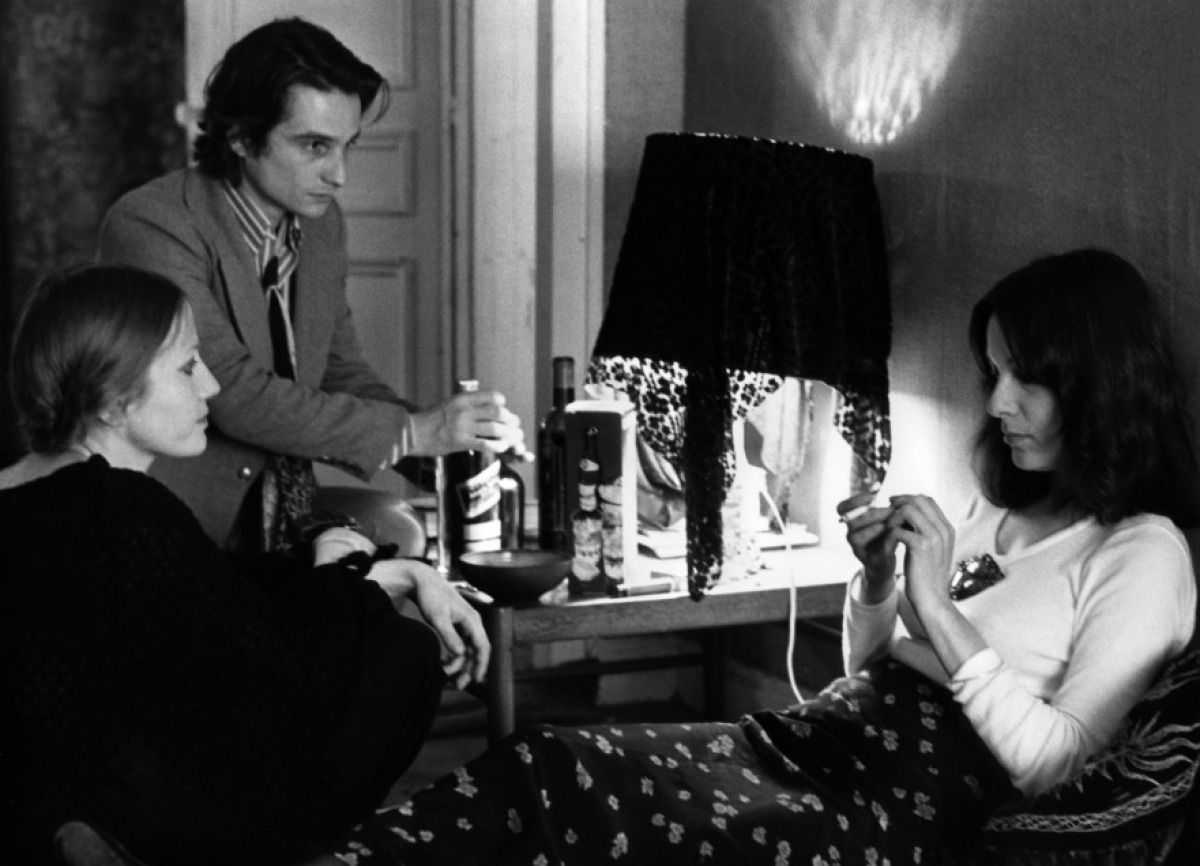


Fuckboys, y’all. They’ve been with us forever. There’s just no getting around how much of twentieth century culture is built on the foundation of that special kind of insecurity that leads someone both to try and sex their way through the neighborhood while at the same time clinging to someone in a death grip of promises and misguided intentions. Now, monogamy can mean a lot of things- you’re coming to see a French film at the Belcourt, so that’s already a concept that you get, at least aesthetically. But this film, The Mother And The Whore, is focused on that cornerstone of civilization about what’s good for the goose being good for the gander, oh Sheila indeed.


We’ve all known a guy like Alexandre. Perhaps not someone coping with the collapse of their ideals following the 1968 Paris riots by dabbling in misogynist sportfucking, but I bet a decent amount of you know a former liberal thinker who let their inner reactionary out after 9/11. Or someone whose social media let out their unsuspected incel tendencies. Some folk here might even be like Alexandre, though I don’t know if it’s even possible to smoke as much as this fictional character does and still be puttering around, because if you are trying to quit smoking, tonight is not going to be the night for it. But if you’re trying to quit a guy who can’t help but disrespect you because he’s stuck on a continuum between the deepest, crippling insecurity and the most stereotypical, visceral horniness, well you are in luck. Even moreso, how a guy responds to the end of this film is a gift to the world from filmmaker Jean Eustache, because it’s not quite a pulsating neon sign or anything, but it is what we call pretty damned close.


I’m glad you got to see the trailer for the new Ira Sachs film, Passages, before this, because it is a great companion pieceto this film- there are certain speed bumps that loom before any triad, regardless of the gender expression of those within it. Although funnily enough, in depicting this situation in the age of texting and eCommunication, Passages runs ninety minutes. So some doctoral student in mathematics can actually figure out how much more quickly our lives have been greased on toward oblivion by our technology.


This is a film about a lot of things, but chiefly are pleasures and pains of conversation. And that’s why I wanted to do this little address beforehand. Because the first time I saw this, in 2010, it was thanks to friend of the Belcourt/occasional Nashvillian and brilliant artist Harmony Korine, who programmed it with his then-new film Mister Lonely. And it was a pain in the ass to make happen. The French Consulate had to be involved. Agnes B had to be involved. It was a big deal. And I appreciated the film because there are few things that make the heart go zing like high contrast black and white. But when I watched it again last October at the New York Film Festival, they premiered this restoration alongside special guest Francoise LeBrun (whom we had recently watched masterfully holding court in Gaspar Noe’s Vortex), who had been unable to attend the film’s US premiere at the 1973 NYFF because she was pregnant. So it took fifty years for New York to catch up to her. And as for me, standing here on my forty-eighth birthday, it’s not so much that time caught up to me, more that it slammed full-tilt into my ankles and left me in a state of teleological confusion with great wailing and gnashing of teeth. But what struck me was the most controversial aspect of the film.


It’s never not been controversial. This film, for fifty years now has been messing with people’s minds and senses of propriety. * But what seemed most controversial about it during the screening last October was the new subtitle translation- which I found a revelation, making the film exponentially more relatable (and mordantly funny), but which seemed to piss a lot of people off. I'm not a native French speaker, but I know hardcore cinephile, and I know the ways of consumptive sadness and the way that sexual pathology can get all up in your syntax. So we'll just say that I found this restoration of the film a revelation. And I hope it provokes a response in you that helps you find some form of catharsis. 


Also, here is a picture of Francoise LeBrun at that aforementioned New York screening last year. She's the coolest.


15 January 2016

Madonnarama.

Madonna is coming to Nastyville. Seventeen year-old me's mind just imploded.

14 October 2015

The Decline of Western Civilization 2 and Wes Craven's New Nightmare.

 I am fortunate to have an outlet for publication that will follow me into some weird-ass places. Thus, you have this number, wherein I discuss how you could spend one night at the same theatre watching both Wes Craven's New Nightmare and The Decline of Western Civilization Part II: The Metal Years. Just give it a read- I have a theory and such.

14 February 2013

Kam chang leepa sank tones, all around.

This weekend, I'll be hosting The Belcourt's midnight screenings of "Sine Yo Pitty On The Runny Kine," starring Pootie Tang. You know you need to be there. Wapatau to the bammies...

11 October 2011

At the movies: El Bulli - Cooking in Progress.


Initially, the whole idea of molecular gastronomy seemed a bit much for me. But thanks to some patient friends (much respect to Christopher and Beasley for showing me the way) and some amazing photography, I've since developed a sincere appreciation for the art and joyful madness of Ferran Adria and his staff of geniuses. Experience the love/madness for three days only as part of The Belcourt's Doctober.

10 September 2011

Miranda July Live in Video

So tonight, at Nashville's venerable Belcourt Theatre, following the 6:30 screening of The Future (regualr admission prices, $8.75 for adults, $7.25 for students and military with active ID, $6.25 for seniors, and as always, $5.75 for Belcourt members), there's going to be a Skype discussion with writer/director/star Miranda July. This is not a chance that comes by too terribly often, and you'd be in for a special treat. In addition, after the discussion, you'd be right on time for our free outdoor screening of Psycho. So that's an evening right there. Don't miss it.

04 August 2011

At the movies: The Hitcher.


Two shows only. This weekend. As part of The Belcourt's Road Movies of The 70s & 80s series. A new print, fresh from the UK. The original, and still champion- The Hitcher.

14 July 2011

At the movies: "Liz & Losey."


To close out its two-month, eight-film tribute to the legacy of Elizabeth Taylor, The Belcourt Theatre in Nashville is ending things with a double feature of Taylor's 1968 Joseph Losey collaborations Secret Ceremony and Boom!

Neither of these films have been released on DVD or any of the various streaming/on demand services, so this is probably your best chance to experience them in a semiluxurious (and mercifully air-conditioned)setting, so perhaps you should consider such a thing. Also, while both films snuck out on VHS during the downward spiral of that format, Boom! was released in a viciously cropped version that completely obliterated its full Panavision dimensions.

I talk about both films in the current issue of The Nashville Scene. You're soaking in it...

19 January 2011

At the Movies: Rabbit Hole.


So here is the sprawling, 1,000+ word review I got into both Metromix and The Tennessean. It's a great film, and it was a hell of an assignment. As a special bonus, you get a little bit of a sketch of the screening attended by Nicole Kidman, which was, for a moment, the biggest art event in the city. Kidman is a doll, graceful, humorous, and supersweet.

29 April 2010

At the movies: Notorious.


Thank to the folks at the Nashville Scene, here's my pick for this week's Belcourt screening of 1946's Notorious. Which for some reason is illustrated with a photo from the Notorious B.I.G. biopic. Which is kind of funny.

04 December 2008

"No dream is ever just a dream." Notes on Eyes Wide Shut.

I was fortunate enough to introduce a screening of Eyes Wide Shut as part of the Belcourt's Stanley Kubrick retrospective. I had a lot of people ask about several of the things I mentioned during my little talk, so I figured I would post the notes I used that Wedensday night.

I only got to cover about sixty or so percent of what all I had written, but it was such a thrill to see a 35mm print of the film (and to talk with people afterward) that I would put it all up here. Part sentence-outline, part flow-chart, I can't say that it works aas a logical piece of criticism, but it covers all the bases on the film that I wanted to get into.

I was also sent an article by one of last night's attendees about the film that is absolutely delicious analysis and criticism of the film. Many thanks to Richard K for hepping me to the Krieder piece.

NO DREAM IS EVER JUST A DREAM: Notes on EYES WIDE SHUT

1 Obligations.
For the story, of marriage.
For the audience in 1999, of sexual content and the ‘event’ of a Kubrick film, a posthumous one at that.
For the characters, of society. Drudgeries of work, the process of Christmas (presents, parties).

Temptation takes the Harfords for a dance

Made in the shadow of the Cruise/Kidman marriage, now a memorial of it.
Other marriages have crumbled in its wake. “Taking the day off to figure out who he was.”
At the beginning, Bill takes Alice’s body for granted. Literally or figuratively, this is his journey back.

‘the grass is always greener’ somewhere, it seems.
Rainbows recur (costume shop, two women at the Christmas party)

The Wizard of Oz as deconstructive journey home
Kidman’s current turn in the vastly underrated and utterly insane Australia.

Trust does not necessarily imply a common interest
Sex and its weird power- it binds them together, comically but firmly, in the final line.


2 What we see and what we do not.
Jennifer Jason Leigh, Harvey Keitel as well.
The women at the masked ball; the carpet doesn’t match.

We don’t know the real story behind Nick Nightingale and the multiple Mandies.

The Harfords’ NYC apartment, big enough for sinuous tracking shots-
Ths Shining’s steadicam shots and vast spaces of menace and portent are explicitly doubled with the slinky curves of Kidman’s body in a cocktail dress and the mystery ball Bill so desperately wants to experience. Kidman has a Steadicam spine, like a Modigliani painting. Compare the Zieglers’ Christmas party dance with the New Year’s Ball at the Overlook.

“Staged… charade… fake.”

Eyes Wide Shut, by virtue of its ethos of available light and the many scenes lit by Christmas trees, pushed two stops, represents a camera philosophy even more radical than Barry Lyndon.
The elimination of shadow detail means there is simply no place for anything to hide. Minority Report loved grain this much

Schnitzler’s Traumnovelle
Freudian, but not in terms of symbolism, more in terms of using dreams as deconstructive tool.

Dream logic – italo horror, Silent Hill film adaptation, eXistenZ

The backprojection work is stunning, especially 4th street as it crosses Sixth avenue.
Malik Hassan-Saeed (Lauryn Hill’s “Ex Factor” video)

The two party/ball sequences cut directly to the return to the Harford home.
There is no diegetic travel, merely a cut. Scenes of travel, therefore, are significant.


3 Fear and Desire.

If you came to this film for flesh, you have it before the title card is even revealed. So where do you go from there?

As an analysis of male sexual insecurity, this is up there with Lynch’s Lost Highway.

Fear of what you might find keeps sex at bay:
The cancer during the breast exam
The HIV (Domino), contrasted with Mizzi’s illness and Fridolin’s fear of diphtheria in the Schnitzler.
The abandonment

The whole stoned argument like a Bene Gesserit training exercise, feinting text and subtext.

Yet every step he takes questions Bill’s masculinity, except in the mirror with Alice and the flirtatious hotel clerk (there’s the Barry Lyndon comic queerness again)
Any attempt he makes to assert his sexuality leads to the abyss.
NY Post headline “Lucky to be alive.”

Kubrick the perfectionist did something in this film that we had never been allowed to see: he ground the movie star out of Tom Cruise. He seems out of place, never in control in any situation. When he tries to use what we perceive as his iconic charm, its effect is off-time. He tries to react like a movie star: money, baked goods, charm, everything- we seem him lose his edge in real-time. Cruise drained of star power; given his recent difficulties, imagine, then, how the hundreds of takes must have been.

This sexparty is very Prussian, a very ierarchical orgy at the masked ball- voyeurism as a thing of the upperclass?
The digital figures are emblematic of Bill’s own yoyeuristic tendencies. We want to see acrobatic sportfucking, too.
The vast majority of masked ballers are voyeurs, not participants

Bill throws $ around like candy
Commerce of desire; in this case, knowledge.

My, how Stanley loves bare breasts pressed against formalwear (cf Barry Lyndon)

Orgies we have known
Fellini, Cecil B DeMille (The Sign of The Cross)
Emanuelle in America introduces the spectre of death.


4
There is no definitive version of the film.
A) grainy initial international version, 35mm, no digital obstruction in orgy sequence, crew reflection present, unsynched Kidman line.
B) grainy US version, 35mm, with digital obstruction in orgy sequence, crew reflection present, unsynched Kidman line. This is what we’ll be seeing at the Belcourt.
C) smoothed international version, 4:3, no digital obstruction in orgy sequence, now out of print
D) smoothed international version, 4:3, no digital obstruction in orgy sequence, bhagavad-gita extracts removed (though actually Tamil love song)
E) smoothed US version, 4:3, with digital obstruction, Tamil extract removed
F) Hi-Def 16:9 master, smoothed international version, Tamil extract removed

R. Lee Ermey vs Todd Field

Ligeti’s Musica Ricercata and what it represents.

Mystikal – “Shake Ya Ass” much in the way of 2 Live Crew’s “Me So Horny” was for Full Metal Jacket.
It’s Always Sunny in Philadelphia (The password is ‘ooooooor-gy’).
Season Two of True Blood (oops, I’ve said too much)
30 Rock joke about playing piano for those rich weird people

11 October 2008

Kubrickrolled.


The time has come for you to get your Kubrick on.

And it looks like I will be introducing Eyes Wide Shut at some point during its three-day run. Mark my words, it will be worth it.

04 September 2008

At the movies: Make-Out with Violence.

So, my review for Make-Out with Violence got an actual URL, but, as usual, it's slashed down a bit.

So, here's my Director's Cut review. The film is playing at 6:45 and 8:30 PM at the Belcourt on Wednesday, September 10th, and I'd advise everyone to try and check it out.


MAKE-OUT WITH VIOLENCE

There’s an austere and bloody beauty to this film, a languid charm, and a deeply poetic sense of possibility. I’ve never seen anything quite like Make-Out with Violence, a locally-made marvel that tramples genre expectations while delivering interesting characters and a tangled net of believable and affecting relationships. This could have been a slice-of-life dramedy and worked beautifully; it could just as easily have been a straight-up splatterfest and left the most ravenous of audiences satiated. But the film finds its own path, and beautifully.

There’s a dash of Return of the Living Dead 3 here, skulking around in the background. Similarly, you can feel the open, implicitly southern laconic openness of David Gordon Green’s George Washington and All the Real Girls. But Make-Out with Violence is such a fully-realized original vision that the only thing I could honestly compare it to with any degree of authority is Sofia Coppola’s masterpiece The Virgin Suicides (there’s certainly a thematic echo there, but Make-Out is far less dreamy and more focused on the specifics of loss and desire). Whether you take the zombie story at the heart of the film as a literal exploration of what happens when love leaves and you’re left with only flesh, or if you’d rather see it as an extended metaphor for the Darling boys’ metabolizing their grief, there’s no denying that what The Deagol Brothers have put onscreen is like nothing else to come out of the city before, and moreso a staggeringly promising debut.

There’s a sense of community to these characters, and one of the film’s strengths is the way it allows all the different connections between characters to unfold organically, shading in the little details of the hearts being juggled at its center. Make-Out with Violence understands young love; how it transforms bodies, disrupts allegiances, turns friend and family against one another, and sometimes offers a way in- or a way out.

The horror and dramatic elements are in perfect balance (with only a couple of overly comic scenes breaking the film’s sensuous and hypnotic spell), and there’s a cumulative sense of haunting, literally and figuratively, that gains strength throughout, culminating with a finish that weaves shock, resignation, and a palpable lament for what was and what was lost. There’s a stark emotional truth at the center of the film that most movies, of any size or budget, just aren’t interested in exploring. But Make-Out with Violence can sit proudly alongside Black Snake Moan and The Heart is Deceitful Above All Things as examples of Tennessee filmmaking at its most uncompromising and enduring.